Midcentury Meets Modern in the Midwest
Interview with Susan Yeley
Photography by Sarah Shields
Indiana-based interior designer Susan Yeley discusses how she made a cozy yet dated home more functional and contemporary for a Bloomington family.
Was your path to design straightforward?
It was more of a beautiful zigzag. I was a dual English/Spanish major in college and went to graduate school at the University of Chicago for philosophy and religion. While doing the latter, I accepted an unpaid internship at the Merchandise Mart, a furniture-and-fabric showroom, just to see what the design world was about. Soon after, I switched from U of C to the Harrington Institute of Interior Design. I eventually took a job at a high-end residential firm in Chicago before moving back to Bloomington and gradually starting my own.
You use the term “Bloomerangs” to describe Bloomington natives who return to the area. What makes these particular Bloomerang homeowners unique?
First and foremost, they’re easygoing people you’d want to be friends with. I like to call them unicorn clients because they’re very trusting of designers’ expertise yet also bring great taste and a sense of fun, wanting their spaces to be interesting.
This house belonged to friends of the wife’s family; she remembers going there as a child. She and her husband were living in New York but wanted a home base here to be closer to loved ones. The job itself took a few years: they weren’t initially planning on doing any extensive architectural changes, but as we delved in, we saw possibility! It was a privilege to tackle their entire home, and it gave us the opportunity to make the color palettes and materials cohesive. As a result, the rooms flow together, adding a whole other level of joyfulness. It was a terrific collaboration overall; I really feel as if we were gifted these clients.

Was it challenging to balance the old with the new, especially considering the wife’s history with the house?
Actually, it was fun trying to figure out how to maintain its history while also making it livable and functional in the 2020s. After all, we live differently than people did in the midcentury—we’re more casual, for instance, and are willing to admit that we clean and cook.
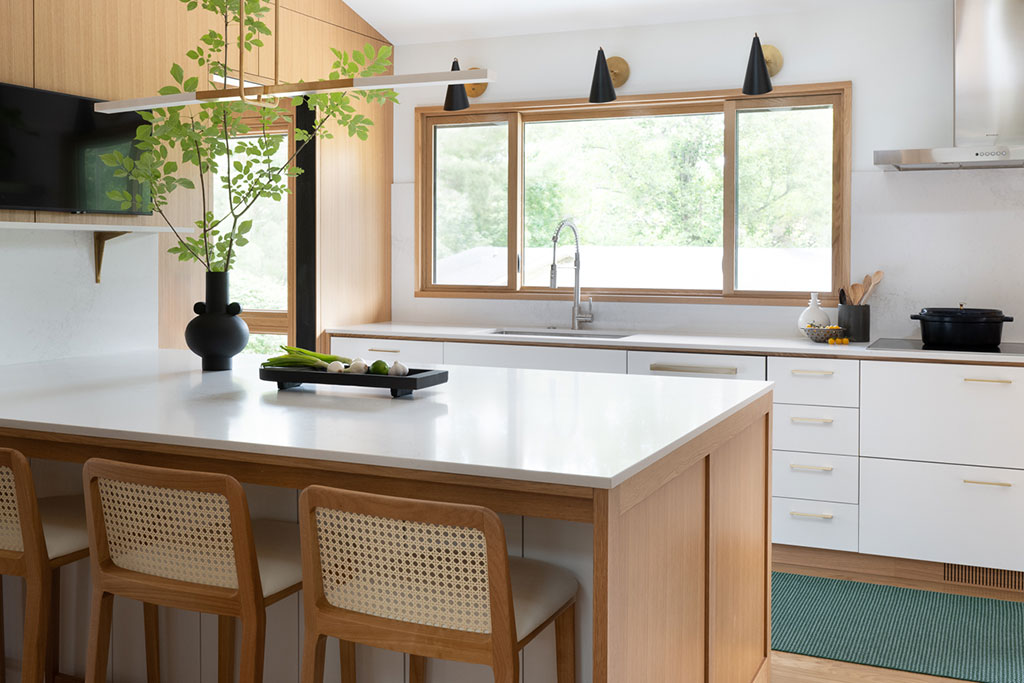
Regarding the latter, the house had a terrific little breakfast nook, but the kitchen itself was small— just a place where one person could make dinner and then take it out to the dining room. These folks love to cook and entertain, however, so we expanded the kitchen footprint into the breakfast nook and, as hard as it was to give the nook up, opened it all up into the hallway behind it.
The living room really stands out. What steps did you take to modernize it?
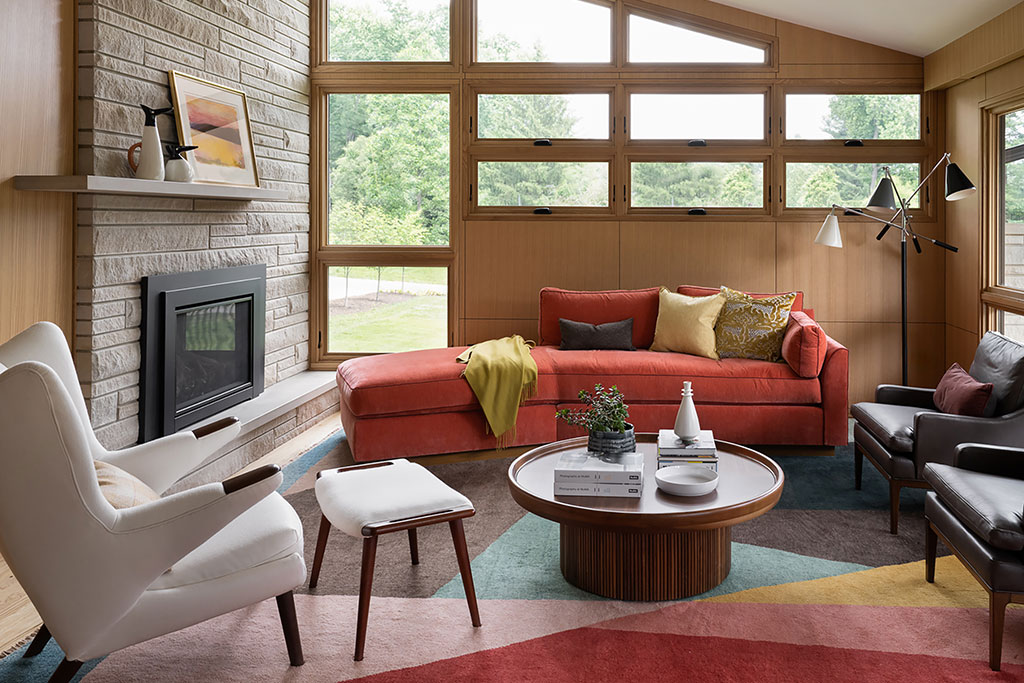
We took down the existing paneling that was on many of the house’s walls and replaced it with new white oak paneling, which is seen around the whole perimeter of the living room. The original was quintessentially midcentury but not great quality. We carefully laid out numbered panels that had to be installed in chronological order because the grain was continuous—that was a bit tricky, but it turned out beautifully. We also added windows to augment the connection to the outdoors, a very important element of midcentury residential architecture.
As far as the furniture, the couch is distinctive because it’s angled, featuring a custom-designed wedge that gets a little wider as it extends toward the fireplace so people can put their feet up. Fortunately, these clients didn’t want a TV in the room, allowing us to leave the fireplace as is and make the space conversation focused.
You mentioned light, which is ample throughout. How did it inform your design decisions?
We can’t get enough light! That said, light is actually one of the worst things for your textiles; it fades upholstery. In the living room, the angled windows adjacent to the fireplace face south, allowing sunlight to pour into the space, which is wonderful, but we had to put a light-filtering film on them. The painting above the fireplace is a pastel, so we also enclosed it in museum-level glass for protection. Similar considerations were made for the art in the bathrooms, not only because of the light but also the humidity.
The main bedroom has tremendous height, yet it seems very comforting. Would you explain how you achieved that?
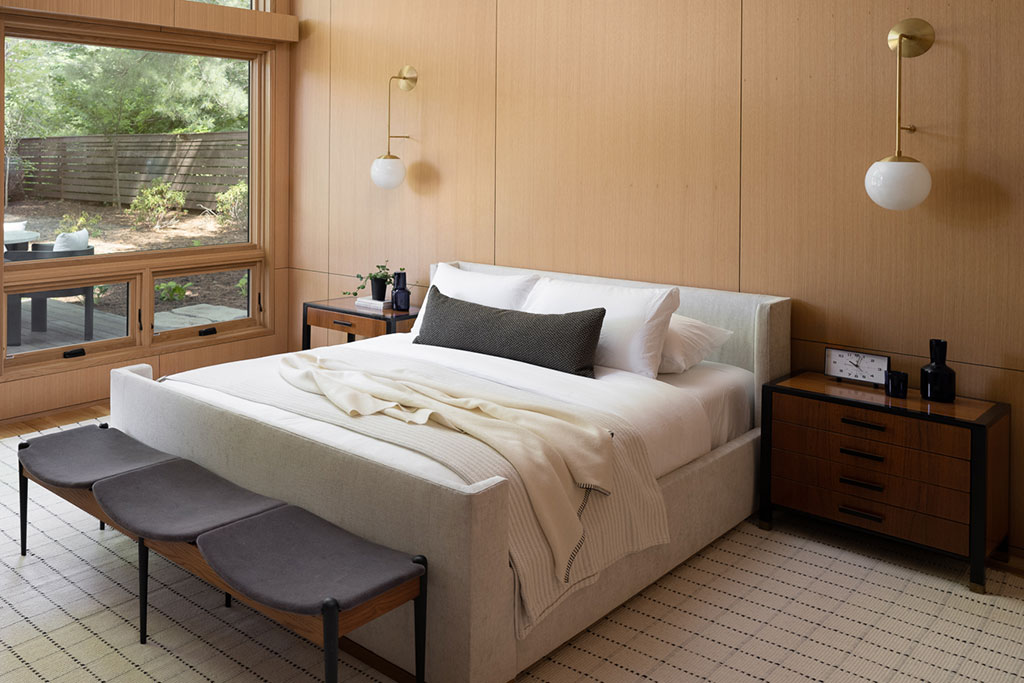
You nailed the problem: no one wants a bedroom that makes them feel like they’re in the Library of Congress lobby. We kept this room’s shell but gutted the rest and added the windows, which mimic the originals in the living room. The armoires along the wall have loads of storage space but only go up eight feet, which brings the eye down. The paneling on the walls also adds a warm touch, making the space feel not quite so grand and lofty while evoking cozy midcentury vibes.
Tell us how you went about updating the basement:
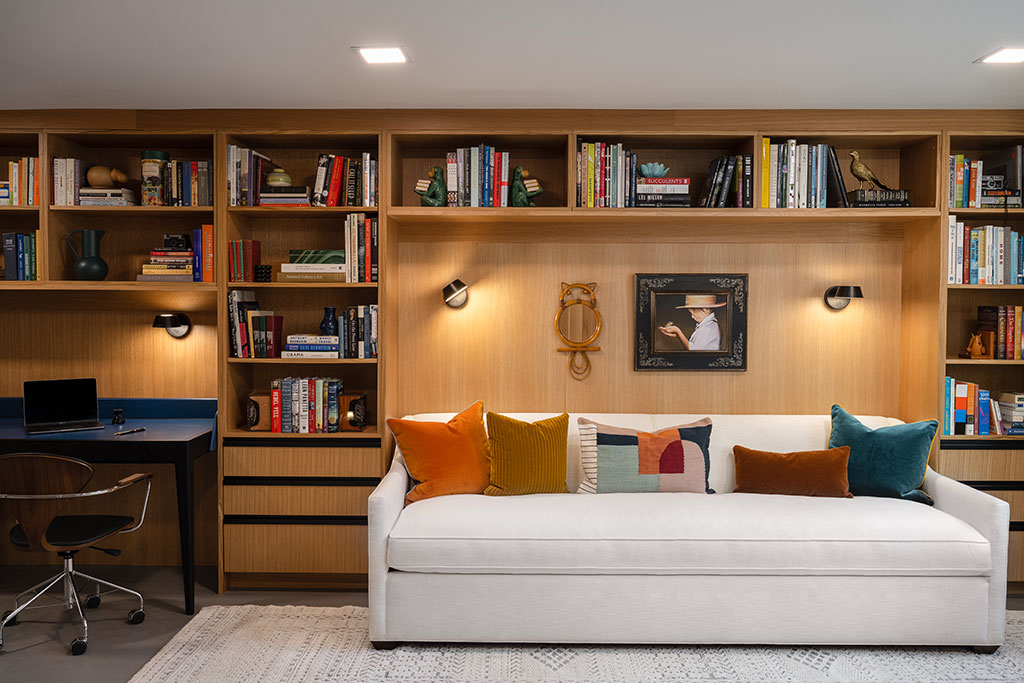
Much of our town is built on limestone, so basements here tend to get wet. But these clients ensured that theirs was dry and clean, making it easy for us to create a beautiful and useful space for them there. We installed new custom stairs and shelving and, because the husband works in film, added a comfy sofa and a huge screen back in the dark interior. We also wanted it to be an extra space for visitors to stay, hence the white pullout sofa from Clad Home and full-sized tulip table, which can be pulled over for eating breakfast or having a cup of tea away from the chaos that might be happening in the kitchen. Overall, it turned into a great little underground living space. I don’t always like underground living, but this is a basement I’d want to hang out in!
You’ve said that you value understated perfection. Would you elaborate?
One of my favorite things about doing design in this part of the country is the accessibility that many people here want their homes to have, which reflects shared Midwestern values and is present regardless of a client’s financial situation or taste. This house has a beautiful architectural line, but you can’t tell from the street how luxurious it is or the level of craftsmanship that went into the design. That was intentional, but the modesty is deceptive: every inch of this house was designed to be perfect, if understated. There’s a thoughtfulness in this kind of work—we are really artistic and purposeful but don’t necessarily want to shout it from the rooftops. This quality may not be unique to the Midwest, but it’s certainly common here.
This year marks your firm’s twenty-year anniversary. What does that mean to you?
It’s still fun work to do, and I don’t just mean the design. When you own your own company, you do a little bit of everything: shopping, designing, marketing, networking, finances, etc. But I also get to interact with all kinds of people, from my incredible team to our clients, contractors, tradespeople, artisans, and makers. It continues to be very satisfying for me to work with homeowners and feel the impact our art makes in their lives.
For more info, visit susanyeleyhomes.com
4915 Views
Related Posts





Popular Posts